


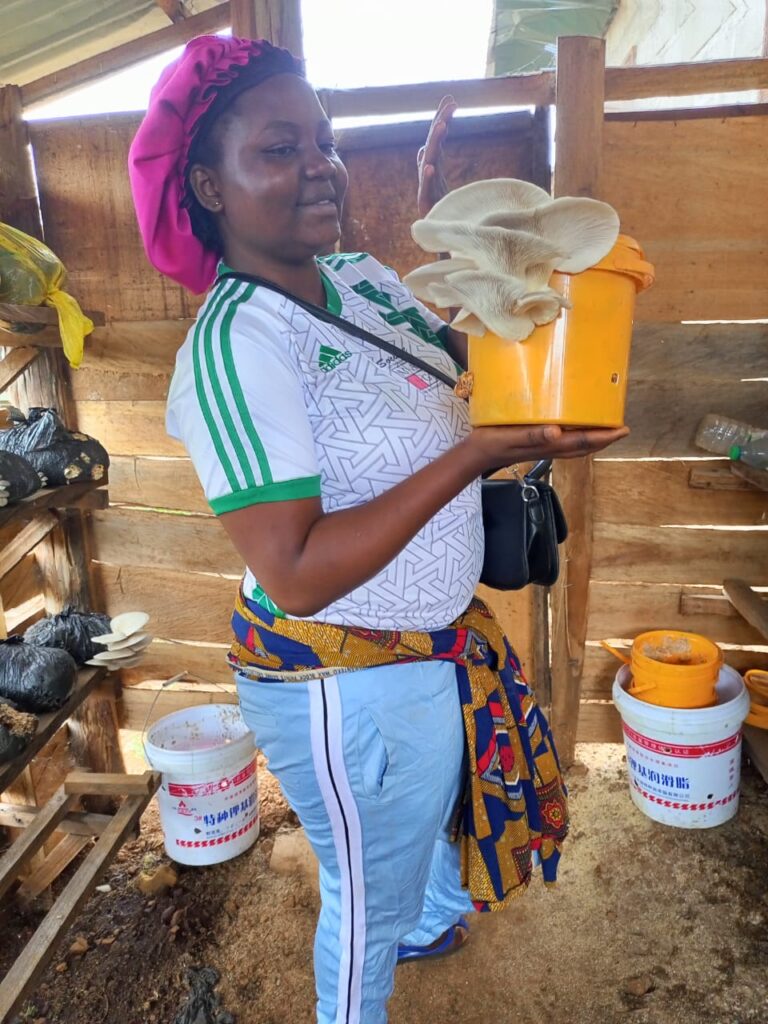
Tim Felicia Nain displays freshly harvested oyster mushrooms at her small-scale farm in Nkambe, North West Cameroon
In Nkambe, 30-year-old Tim Felicia Nain, a graduate of University of Buea, is quietly building a livelihood from an unlikely source: oyster mushrooms.
Nkambe, the administrative capital of Donga-Mantung Division in Cameroon’s conflict-affected North West Region, has faced its share of economic challenges as a result of ongoing conflicts. While relatively calm compared to some surrounding localities, economic opportunities remain limited, pushing many young people especially women towards small-scale entrepreneurship.
Felicia’s journey into mushroom farming began in October 2025, inspired by a local training initiative led by Hearts in Action Cameroon. The organization introduced participants to sustainable farming methods, including snail, maggot, and mushroom cultivation.
“What caught my attention was the nutritional and pharmacokinetic value of mushrooms, their short growth cycle, and the relative ease of cultivation,” she said. “It allows me enough time to take care of my child and my home.”
Starting with a modest capital of 100,000 FCFA (about $178), Felicia admits her early attempts were far from successful.
“I wasn’t quite experienced in my first try, so a lot of my mushroom substrate got contaminated due to bacteria and improper sterilization,” she said. “I later changed the substrate from corn flour and sawdust to rice bran, and that worked better for me.”
Through persistence, online learning, and guidance from a local expert, she gradually improved her techniques. Today, her small farm produces about 5 kilograms of fresh oyster mushrooms weekly an output that is increasingly in demand in local markets.
“The nutritional value and good taste of oyster mushroom cannot be overemphasized,” she said, adding that mushroom she cultivates offer protein, fiber, vitamin B, and minerals like potassium, iron, and zinc and equally taste very good”
Despite her progress, Felicia says demand continues to outstrip her supply.
“The demand is so high, but I don’t have the resources to produce what the market requires,” she explained, pointing to limited infrastructure and difficulties in accessing quality spawn.
Her challenges are compounded by logistical and environmental constraints. Sourcing spawn and transporting it to Nkambe remains difficult, while pests, particularly rats pose a constant threat due to the lack of a proper cultivation facility.
“At present, my farm is still small and cannot accommodate many bags or buckets because of financial constraints,” she said.
Yet, her ambitions remain firmly rooted in growth.
“If I could get a suitable structure and reliable spawn, I would immediately scale up production, supply mushrooms to more regions, and even explore export opportunities beyond Cameroon,” she said.
For Felicia, mushroom farming is more than just a business, it is a survival strategy in uncertain times.
“The oyster mushroom farming has helped me survive during this crisis,” she said. “It has become a source of income and food for me and my family.”
Her story reflects a broader trend across Cameroon, where young entrepreneurs are turning to agriculture and innovation to navigate economic hardship. In regions like the North West, such initiatives are not only sustaining livelihoods but also quietly rebuilding local economies and providing means of livelihood.
Please I wish to learn mushrooms farming