
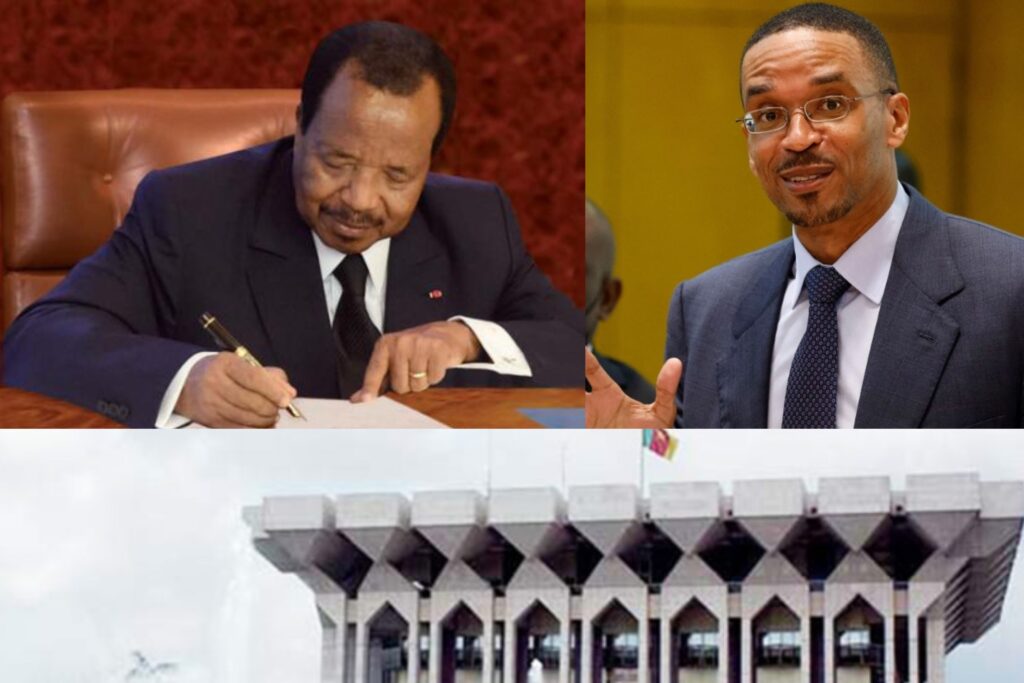
Over the past days, a viral claim has circulated widely on social media alleging that President Paul Biya had appointed his son Emmanuel Frank Biya as Vice President of the Republic of Cameroon through a presidential decree. The document, presented as official, spread rapidly across digital platforms, provoking debate, confusion, and political conjecture.
However, this claim is false. No such appointment has been made. While Cameroon has recently taken a significant institutional step by adopting a constitutional reform that introduces the office of Vice President, no individual has been officially appointed to that position.
The confusion was amplified by the circulation of an alleged presidential decree titled “Décret N° 2026/138 du dimanche 4 avril 2026 portant nomination du Vice-Président de la République et responsable chef des armées,” which claims to appoint Franck Emmanuel Biya as Vice President and assign him additional high-level military responsibilities. The document, however, is not authentic and has not been published through any official state channel or in the Journal Officiel, which is the legal requirement for any enforceable decree in Cameroon.

The document’s structure, content, and absence from official records confirm that it is part of a wave of misinformation that emerged following recent constitutional debates.
The viral rumor gained traction in a sensitive political context following the adoption of Bill N° 2094/PJL/P during the 6th Congress of Parliament, where the National Assembly and Senate sat in joint session on Saturday April 4, 2026 and voted massively to adopt the bill . The bill amends the Constitution of 2 June 1972, as revised in 1996 and 2008, and formally establishes the office of Vice President of the Republic of Cameroon.
According to the adopted reform, the Vice President will be appointed by the President of the Republic, who also retains the authority to define his responsibilities and terminate his mandate. The Vice President’s term cannot exceed that of the Head of State. In the event of a vacancy in the presidency, the Vice President is mandated to complete the remaining term. If both offices become vacant, the Constitution provides for a succession mechanism involving the President of the Senate and other designated authorities in a defined order of precedence.
The reform is officially presented as a measure to enhance state efficiency, ensure continuity in governance, and modernize institutional coordination.
Bicultural Identity and Political Debate
Despite its administrative framing, the reform has framed worries regarding Cameroon’s bicultural foundation, rooted in the reunification of former British Southern Cameroons and French Cameroun. Many believe that such a major institutional change should explicitly reflect this dual heritage.
The Social Democratic Fronts, one of Cameroon’s oldest opposition parties through its national President and legislative representation had proposed that the Vice Presidency should be constitutionally balanced suggesting that if the President comes from one linguistic community, the Vice President should come from the other, as a mechanism to reinforce national cohesion. However, the adopted text does not include such a guarantee, leaving the appointment entirely at the discretion of the President.
This omission has fueled ongoing political discussion about representation, inclusion, and the future structure of executive power.
Franck Biya and Longstanding Succession Speculation
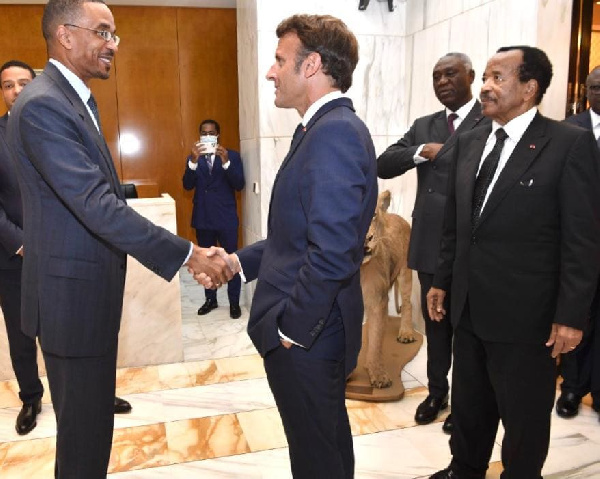
Frank Biya in a handshake with French President in 2022 during Macron’s visit
Within this broader context, attention has increasingly turned to Franck Emmanuel Biya, who, despite holding no official government position, has over the years maintained a discreet but visible presence in certain state and diplomatic environments.
His presence during high-profile events, including the 2022 visit of Emmanuel Macron to Cameroon, as well as his occasional proximity to official state ceremonies, has contributed to long-standing speculation about succession narratives in Cameroon’s political landscape.
In some political and social circles, these appearances have been interpreted as indicators of gradual political positioning. However, there has been no official designation, appointment, or constitutional link connecting him to the newly created office of Vice President.
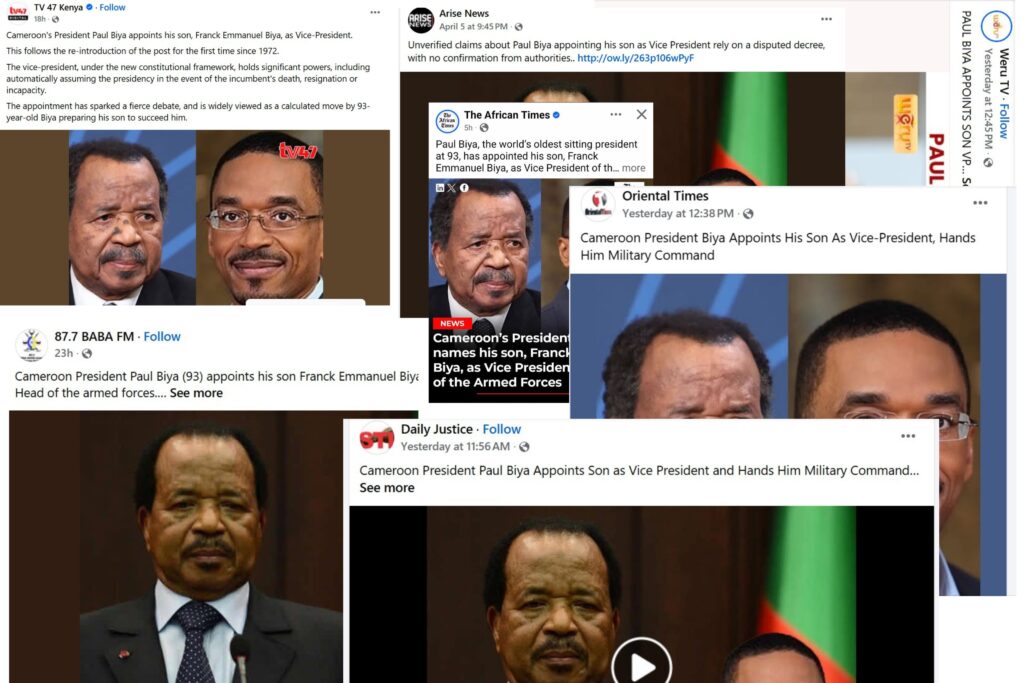
Multiple news platforms beyond Cameroon online reported the false rumour
The speed at which this claim spread is closely tied to three converging realities: ongoing constitutional restructuring, long-standing public debate on political succession, and public interest driven by desire to predict the future.
When these factors intersect, misinformation can appear plausible, even when it is entirely unfounded.
The alleged decree is a clear example of this phenomenon. While completely fake, it gained traction because it appeared to align with a broader political narrative already circulating in public imagination.
What remains clear is that Cameroon has officially introduced a new constitutional office, but no appointment has been made to it. The circulating decree is not authentic, and no legal process has named any Vice President.
At the same time, the intensity of public reaction reveals something deeper than misinformation alone. It reflects how closely citizens are watching constitutional reforms and how sensitive the question of succession remains in national discourse.
For now, the claim stands corrected: it is false.
But its impact highlights a broader reality when institutions evolve, public interpretation often evolves even faster.
Whether this episode is remembered as a simple case of misinformation or as an early reflection of political imagination will depend on what unfolds in the future.