 By admin
 by Tech Desk
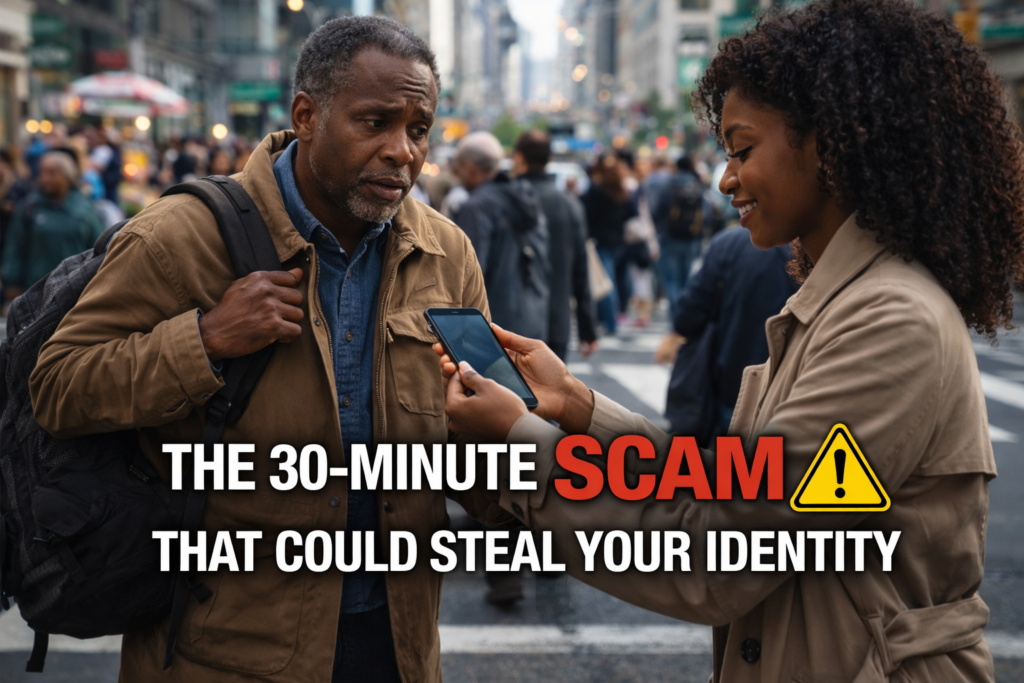
There was a time when scams followed familiar patterns—an urgent email, a suspicious link, or a stranger asking for money. Today, those tactics are evolving into something far more subtle and far more dangerous. The newest threat doesn’t rely on hacking your accounts or tricking you into revealing passwords. Instead, it quietly targets something much deeper: your identity itself.
What makes this emerging scam so unsettling is how ordinary it appears. It often begins in everyday public spaces—shopping malls, transport stations, busy markets—places where people naturally let their guard down. A well-dressed individual approaches, calm and polite, asking for a small favor. They may claim they don’t understand how to use their phone, or that they need help checking something important like a pension or financial application. Nothing about the interaction feels rushed or suspicious. In fact, it feels human.
And that is precisely the point.
What seems like a simple act of kindness can quickly become a moment of vulnerability. The device you are handed may already be running processes in the background—an active video call, a recording feature, or software designed to capture biometric data. Without realizing it, you may be stepping into a situation where your face is being scanned, your voice is being recorded, and even your touch is being logged.
This is where the nature of fraud has fundamentally changed. Instead of trying to access your bank account directly, attackers are now focused on collecting the unique biological markers that define you. Your fingerprint, your voice, your facial features—these are no longer just personal traits; they are digital keys used to unlock financial systems, verify transactions, and confirm identity across platforms.
With the rapid advancement of artificial intelligence, this information can be transformed into highly convincing digital replicas. A recorded voice can be cloned. A captured face can be mapped and reused in verification systems. In the wrong hands, these fragments of your identity can be assembled into something powerful enough to bypass security measures designed to protect you.
The consequences are not always immediate, which makes the threat even more dangerous. Victims may go about their daily lives unaware that anything has happened. Then, days or weeks later, the reality begins to surface—loans approved in their name, accounts accessed without permission, financial obligations they never created. By the time the damage is discovered, it is often already extensive.
What makes this scam particularly effective is not just the technology behind it, but the psychology it exploits. It doesn’t rely on fear or urgency. It relies on empathy. It takes advantage of the instinct to help someone who appears confused or in need. In a way, it turns one of our most positive human traits into a point of entry.
This shift marks a new chapter in digital security. The risks we face are no longer confined to what we click or download, but extend into how we interact with people in the physical world. The boundary between online and offline threats is disappearing, replaced by a landscape where a brief, face-to-face encounter can have long-lasting digital consequences.
Awareness, therefore, becomes more important than ever. Understanding that not every request for help is as harmless as it seems is not about becoming suspicious of others—it is about recognizing how sophisticated modern scams have become. Protecting yourself now means being mindful not only of what you share online, but also of how you engage in everyday situations.
In the end, the message is simple but powerful. Your identity is no longer just something you carry—it is something that can be captured, replicated, and misused in ways that were once unimaginable. A few minutes of caution can prevent months, or even years, of financial and emotional stress.
Kindness remains a virtue, but in a world shaped by advanced technology, it must be paired with awareness.